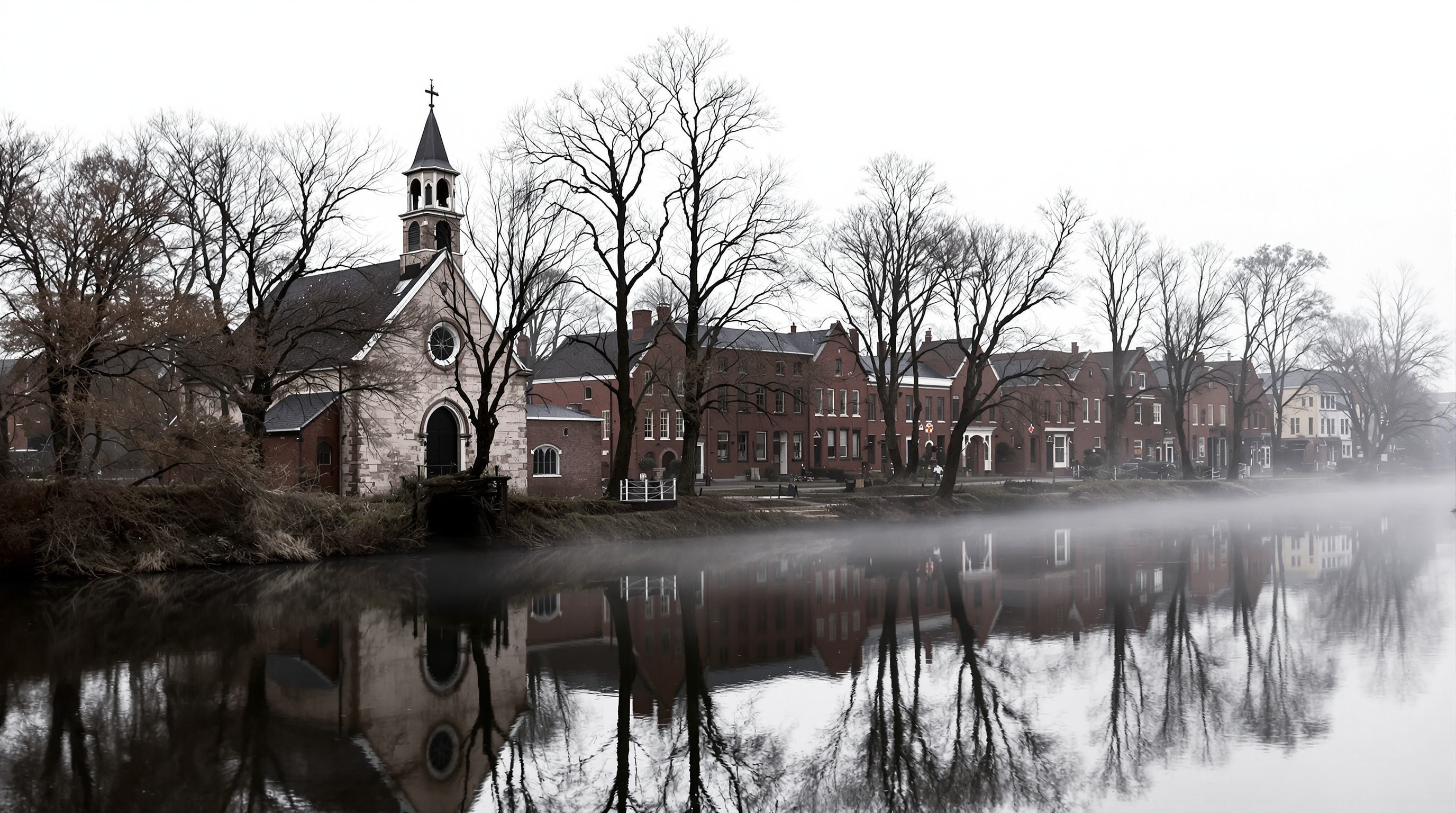
To understand a town's military heritage, it helps to understand the town. Belleville, New Jersey, grew from a colonial riverside settlement into an industrial township, and its long history shaped the community that sent so many of its sons to war.
The Second River Settlement
Belleville sits on the west bank of the Passaic River in Essex County, just north of Newark. In the colonial era the area was the northern reach of the Newark settlement, and it took its everyday name from a stream that entered the Passaic there: the Second River, distinguished from the "first river" to the south. Dutch and English families settled the fertile riverbanks in the late seventeenth and early eighteenth centuries, farming, milling grain, and worshiping at a Reformed congregation whose roots on the river reach back to the 1690s.
Copper, Steam, and Early Industry
The Second River district holds a remarkable place in the history of American technology. In the early 1700s copper was discovered on the nearby Schuyler estate, and the mine that followed became one of colonial America's most important. To keep the deep shafts clear of water, the mine's owners imported a Newcomen atmospheric engine from England in the 1750s — widely regarded as the first steam engine to operate in America. It is a striking reminder that this quiet river town stood, for a moment, at the frontier of the industrial age. Readers interested in the broader sweep of New Jersey history can explore the collections of the New Jersey State Archives.
From Newark's North End to an Independent Township
As the settlement grew, the riverside community increasingly saw itself as distinct. The name "Belleville" — an old French phrase meaning "beautiful town" — came into common use in the early nineteenth century, and in 1839 Belleville was incorporated as a township in its own right. Neighboring Nutley would later separate from it, and the two communities remain closely linked in local history to this day.
An Industrial Town on the Passaic
Through the nineteenth and twentieth centuries Belleville industrialized along with the rest of the lower Passaic Valley. Mills and factories lined the river, drawing waves of immigrant families — Irish, German, Italian, and many others — whose descendants would fill the ranks of the town's honor rolls in the World Wars. The mix of old settler families and newer arrivals gave Belleville the character of a classic American industrial hometown: rooted, hard-working, and fiercely proud of its own.
A Community of Faith and Work
The character of Belleville was shaped as much by its churches and factories as by its founding families. The riverside Reformed congregation anchored the earliest settlement, and successive waves of newcomers built their own parishes and institutions as they arrived. By the late nineteenth century the town had become a mosaic of Irish, German, Italian, and other communities drawn by mill and factory work. These were tight, church-centered, working neighborhoods where family names recurred for generations — and where the departure of a young man for military service was felt not just by one household but by an entire block.
The River as Lifeline
For most of Belleville's history the Passaic River was the reason the town existed. It powered mills, floated cargo to market, supplied the copper works, and connected the community to Newark and the wider world. The same river that carried commerce in peacetime carried news of distant wars, and generations of families watched sons leave along its banks. Understanding the river is a small key to understanding why this particular place produced such a durable tradition of service and remembrance.
Why the History Matters
Every name on a town memorial belonged to a person who lived somewhere along these streets, worshiped in these churches, and worked in these mills. The community's deep history is the backdrop against which its military heritage unfolds — and it is why residents have taken such care, generation after generation, to remember. For a sense of how that remembrance is expressed physically around town, visit our page on memorial street signs.